Concurrently, we identified a material weakness in our internal control over financial reporting related to the identification and monitoring of state and local tax nexus. Although the Company had not received an audit notice, assessment, non-compliance notice, notice of deficiency, or any other communication from any taxing authority indicating that sales tax was due, we elected to submit Voluntary Disclosure Agreements ("VDAs") as a pre-emptive, voluntary compliance action to satisfy potential sales tax and income tax exposure.
The VDA process limits lookback periods while eliminating penalty assessments, and the Company is in various stages of review, submission, acceptance, and payment with each impacted state. Management has also developed a remediation plan for the material weakness, including engaging an independent third-party provider of automated sales tax solutions. That system is designed to continuously identify, monitor, and evaluate our transaction activity and physical presence, with the objective of determining when we are approaching qualifying thresholds in new jurisdictions so we can register, file, and remit accordingly. We will also be evaluating our ability to recover sales and use tax payments made to states that were previously remitted by our clients as part of their own compliance processes. At this time, our focus is on closing VDAs.
If we ran a less conservative balance sheet with significantly fewer liquid assets, like most
The restatement aside, the underlying business is healthy. Retention is strengthening under our new Client Success model, and the playbooks we have built are lifting performance across customer cohorts. Our trade contributor program is experiencing an uptick from direct outreach, marketing campaigns, and our SOC 2 Type I certification. This expansion is particularly interesting as trade providers have higher retention rates, prospects who trial with trade data have high close rates, and growing our trade file directly adds to coverage, improving our services for all users.
Our new Solutions team is finding real demand for collections prioritization and credit limit recommendation workflows, along with our native connectors into leading software and intelligence platforms. On the product development front, our connectors for large language models drew significant client interest and positive feedback when demonstrated at major national events like the NACM's 130th
Finally, our internal experimentation with AI and automation continues to unlock cost and capacity across
We believe that the macroeconomic environment continues to move in our direction. Large
Reported corporate earnings are increasingly dependent on non-operating items: unrealized gains on equity stakes accounted for 71% of Alphabet's and 66% of Amazon's most recent quarterly profits, and excluding those two companies, trailing S&P 500 earnings growth falls from 31% to 24%. This adjusted level of earnings growth is still exceptional, but it highlights the concentration effects caused by market cap-based indexing and circular financing, which compound systemic risk. At the same time, roughly
Private credit is showing the strain we flagged last year, with defaults at the largest managers at their highest levels since at least 2021 and nontraded funds paying out more in redemptions than they take in. What concerns us more is that the disclosed numbers keep proving more favorable than the underlying condition, whether in non-accrual rates that omit borrowers' other debt, liquidity metrics with no standard definition, or the off-balance-sheet commitments described above. Cutting through that gap is the entire premise of what we do. Our PAYCE® Score flagged elevated risk at Tricolor and First Brands more than a year before either filing, and we expect more of the same as this cycle develops. When asset prices and counterparty fundamentals diverge to this degree, our intelligence delivers meaningful value to our clients.
Financial and geopolitical risk remain top concerns for the companies we serve, which continues to drive demonstrations and pipeline, particularly for our SupplyChainMonitor™ product. As always, our north star remains delivering subscription services whose value exceeds their cost to our clients."
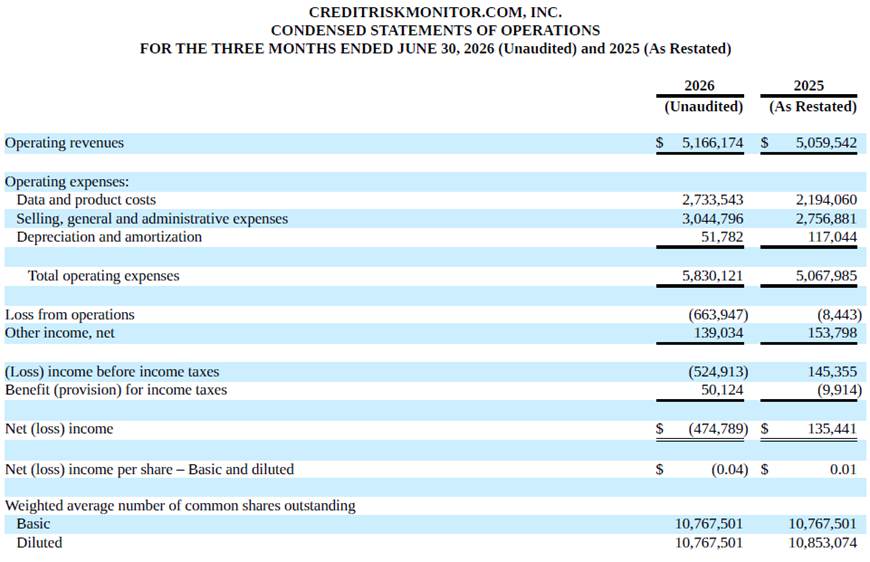
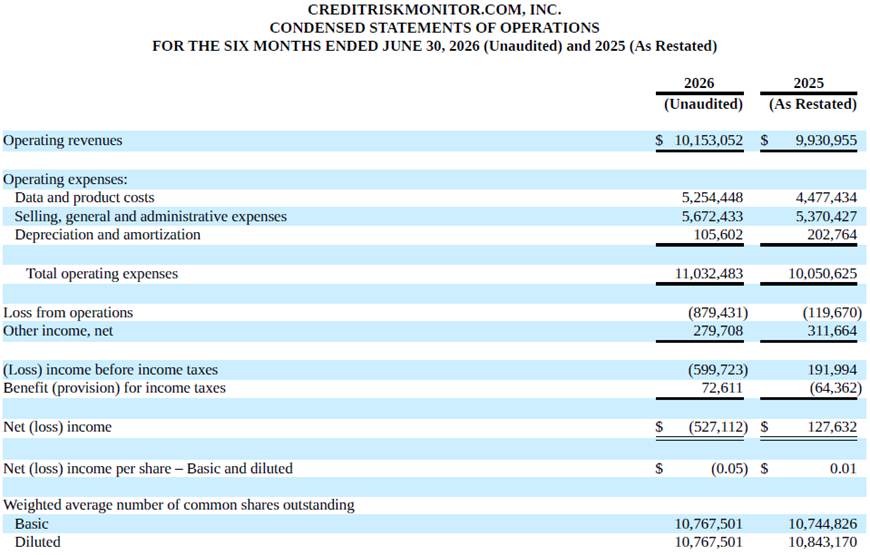
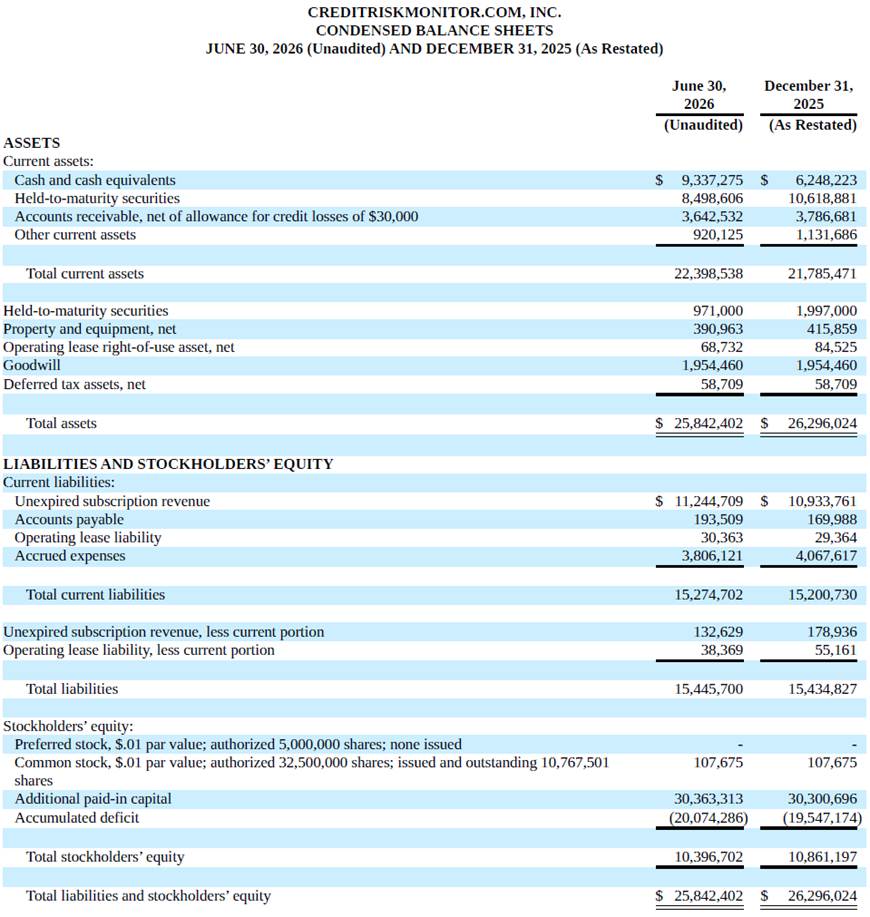
A full copy of the financial statements can be found at https://crmz.ir.edgar-online.com/
Overview
To help subscribers prioritize and monitor counterparty financial risk, our SaaS platforms offer the proprietary FRISK® and PAYCE® Scores as well as the FAST Rating, the well-known Altman Z"-Score, agency ratings from key Nationally Recognized Statistical Rating Organizations ("NRSROs"), curated news, and detailed financial spreads & ratios. Our FRISK® and PAYCE® Scores are financial distress classification models that measure a business's probability of bankruptcy within a year. The FRISK® score also includes a risk signal based on the aggregate research behaviors of our subscribers, who control counterparty access to trade credit at some of the most sophisticated companies in the world. The inclusion of this risk signal boosts the overall accuracy of this bankruptcy analytic by lowering the false positive rate for the riskiest corporations.
Through its Trade Contributor Program, the Company receives monthly confidential accounts receivables data from hundreds of subscribers and non-subscribers, which it parses, processes, aggregates, and reports to summarize the invoice payment behavior of B2B counterparties without disclosing the specific contributors of this information. The size of the Trade Contributor Program's current annualized trade credit transaction data is approximately
Safe Harbor Statement
Certain statements in this press release, including statements prefaced by the words "anticipates", "estimates", "believes", "expects" or words of similar meaning, constitute "forward-looking statements" within the meaning of the Private Securities Litigation Reform Act of 1995. Forward-looking statements include details of the accounting restatement, the expected impact of the accounting restatement and the remediation of the related material weakness in internal control over financial reporting. Such forward-looking statements involve known and unknown risks, uncertainties and other factors which may cause the actual results, performance, expectations or achievements of the Company to be materially different from any future results, performance or achievements expressed or implied by such forward-looking statements, including, among others, those risks, uncertainties and factors referenced from time to time as "risk factors" or otherwise in the Company's Registration Statements or Securities and Exchange Commission Reports. There can be no assurance that (i) the consequences of the Company's restated results will be as anticipated above and (ii) the Company will be able to promptly and efficiently implement the appropriate remediation steps into its financial reporting. We disclaim any intention or obligation to revise any forward-looking statements, whether as a result of new information, a future event, or otherwise.
CONTACT:
CreditRiskMonitor.com, Inc.
Mike Flum, Chief Executive Officer
(845) 230-3037
ir@creditriskmonitor.com
SOURCE: CreditRiskMonitor.com, Inc.
View the original press release on ACCESS Newswire