Upcoming Earnings
AI and Chips Dominate a Blockbuster Earnings Week as Investors Brace for Big Swings
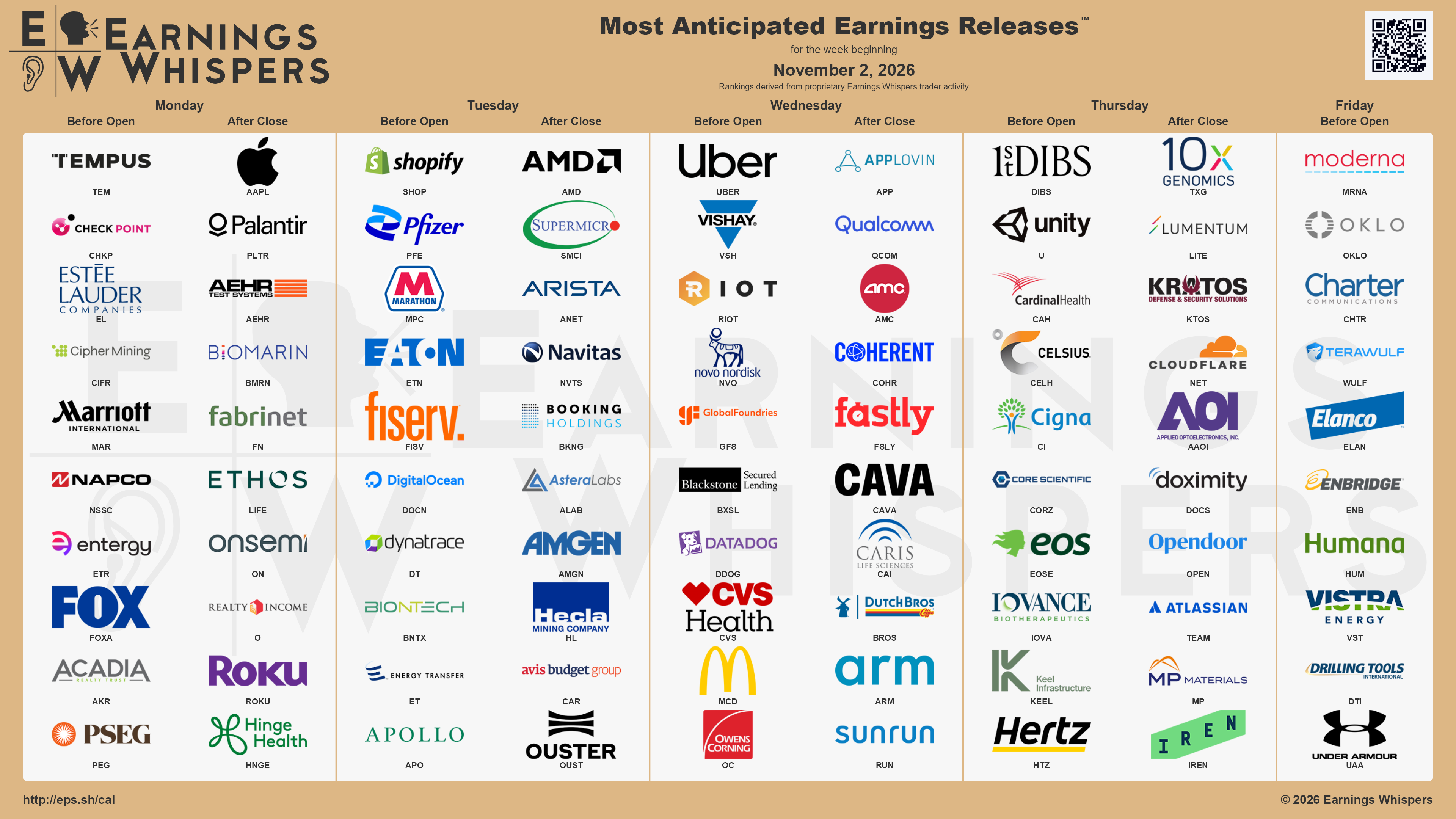
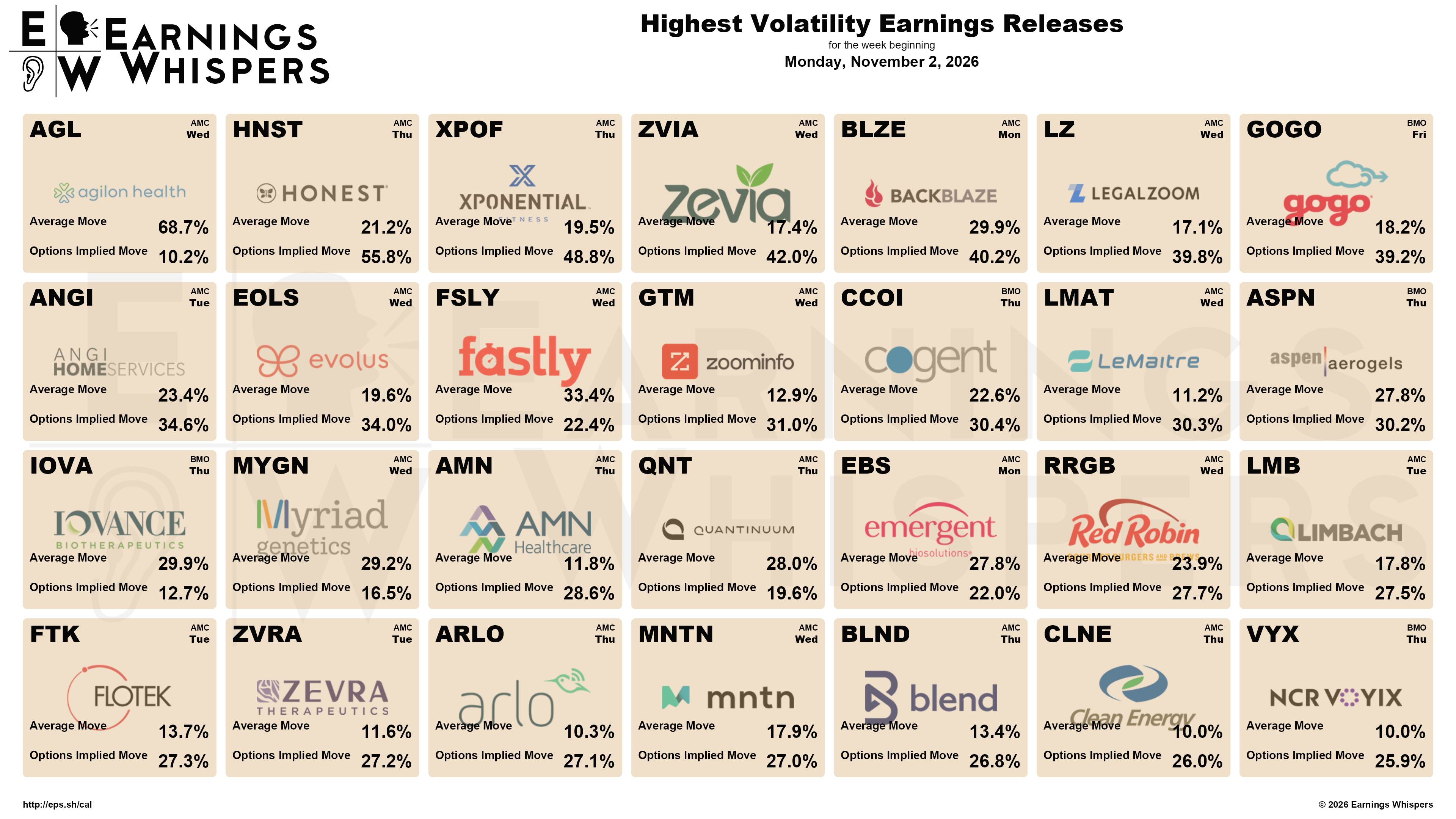
This is one of those weeks where the market holds its breath. The marquee name is Apple, which still commands more attention than any other company on the calendar, though the mood heading in feels cautious rather than euphoric. The real energy is coming from the chip and AI crowd. Palantir arrives riding a wave of enthusiasm and genuine business momentum, and the same can be said for Advanced Micro Devices, which has quietly been one of the best stories in semiconductors. Options traders are pricing in fireworks for these names, with some of the smaller, racier tech plays like Fastly, Super Micro, and Astera Labs expected to lurch by double digits in either direction the moment the numbers hit. In short, if you like drama, the technology sector is serving a full menu.
Beyond the silicon, there is plenty for everyone. Travel and leisure fans get a triple feature with Marriott, Booking, and Airbnb, and the early read on Airbnb in particular looks sunny, with solid underlying trends. Healthcare offers a study in contrasts: Pfizer and Novo Nordisk face a chillier reception, while Cardinal Health and CVS have been building quiet goodwill. Consumer staples lovers should keep an eye on McDonald's and Clorox, both of which look to be swimming against the current, and the speculative corner of the market will be glued to names like IonQ, SoundHound, and a handful of crypto miners that tend to move first and explain later. A word to the wise for anyone tempted to trade the headline alone: several of these companies, especially in the hotter tech pockets, have a habit of popping on the news and then quietly fading in the days after, so the first reaction is rarely the final word.
Apple's Hot Demand Runs Into a Memory-Cost Flood
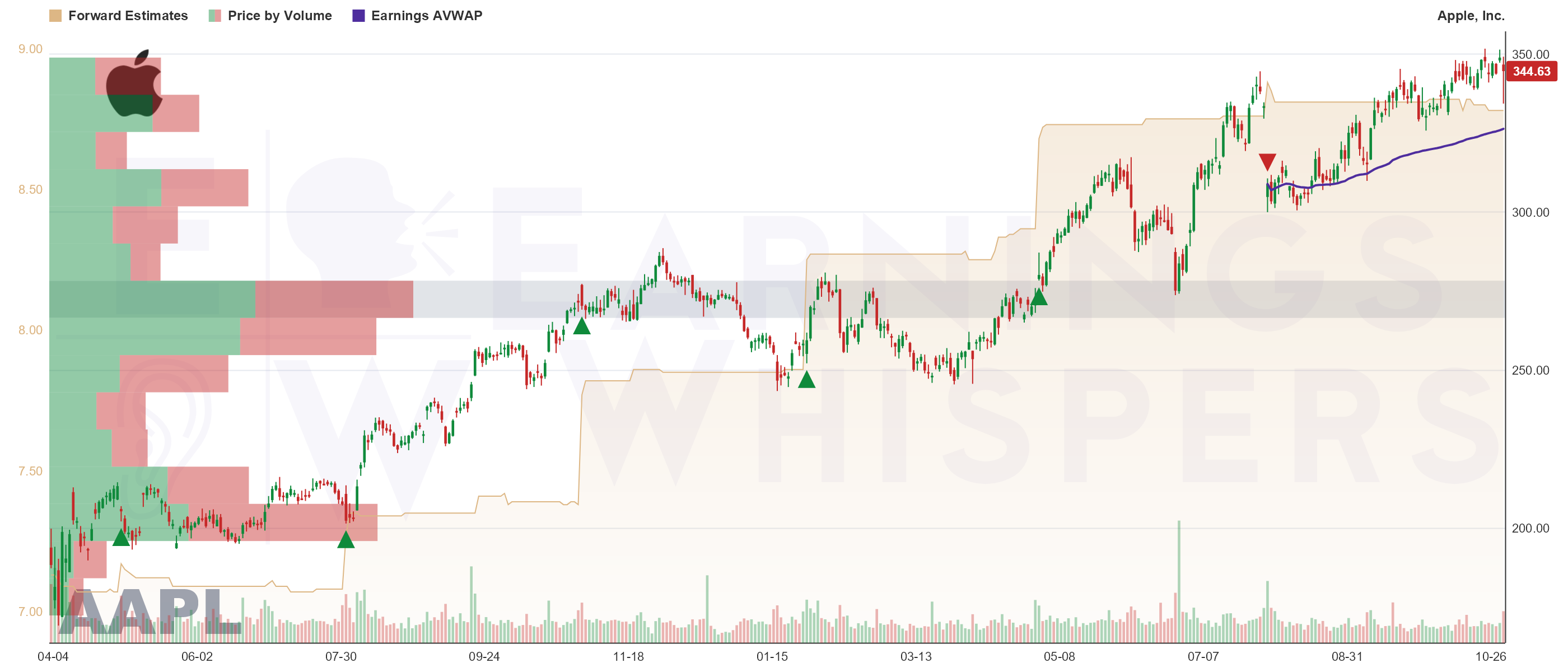
Apple (AAPL) steps up to the plate Monday, November 2, 2026, right around 4:30 PM ET. Wall Street is looking for $1.98 per share on $112.95 billion in sales, which would be a healthy 10.2% jump from a year ago, while the Earnings Whisper number sits a touch higher at $2.07. Apple's own guidance called for $1.91 to $2.04 per share on $111.69 billion to $113.74 billion. Here's the funny part: investors are feeling bearish going in, yet 55.3% still expect a beat, so even the pessimists are hedging their bets. Short sellers have backed off by 10.2% since last quarter, the stock has climbed 13.1% since its last post-earnings open, and it now sits 16.3% above its 200 day average of $296.37. Estimates have been nudged higher across the board. Options traders are bracing for a 4.9% swing, a bit more than the usual 3.0% move, and on October 27 someone grabbed 72,152 of the $380 calls expiring January 15, 2027, a clear bet that the party keeps going.
The real story is a good problem bumping into real trouble. iPhone demand is flat out staggering, with revenue up around 22% and buyers lining up faster than Apple can build phones. But that same shortage is now spreading from Macs to iPhones and iPads, and a so-called hundred-year flood in memory chip prices is squeezing margins hard enough that Apple quietly raised prices across the lineup. On top of that, Services growth cooled off and last quarter's guidance stepped down about 500 basis points. The bright spots are real, the Siri AI rollout is landing well, China approved its AI features, and schools and big firms are swapping out Windows machines for Macs. Oh, and this is the first full quarter with John Ternus in the driver's seat after Tim Cook's handoff. Bottom line: the demand is there, but the margins and guidance are the ones everyone will be watching.
Palantir Heads Into Earnings Red Hot With Bulls Piling In
Palantir Technologies (PLTR) steps up to report after the close on Monday, November 2, 2026, around 4:05 PM ET. Wall Street is looking for $0.40 per share on $2.17 billion in revenue, which would be a whopping 83.7% jump from a year ago, but the whisper number is running hotter at $0.49. The company guided to roughly $2.16 billion, and the crowd is clearly feeling good about this one with nearly 71% expecting a beat. The doubters are heading for the exits too, as short interest has dropped 28% since last quarter while the stock has climbed 26.8% and now sits nearly 20% above its 200 day average of $153.69. Earnings estimates keep marching higher. Options traders are bracing for a 13.4% swing, a touch bigger than the 11.8% average move lately, and one trader made a notable bet buying over 30,000 of the $160 puts expiring in mid December, so somebody is hedging for a bumpy landing.
Here is the real story heading in. Last quarter was about as good as it gets, with total revenue growth hitting a record 93% and management delivering its largest full-year raise ever. The hot new theme is sovereign AI, meaning customers get to own their own model weights and keep everything inside their own walls, which is pulling in big executive interest and even waking up old dormant clients. The NVIDIA partnership and the Maven government platform add more fuel. The only real soft spots are a slight dip in gross margin, since Palantir took on cloud hosting costs for a government client, a big spending ramp coming this quarter, and Europe still dragging its feet. CEO Alex Karp is talking a very confident game and promising strong growth for the next 18 months, so the bar is set high and the crowd expects him to clear it.
AMD's Data Center Rocket Meets a Gaming Speed Bump
Advanced Micro Devices (AMD) steps up to the earnings plate on Tuesday, November 3, 2026 at roughly 4:15 PM ET, and Wall Street is leaning in. The crowd wants $1.94 per share on $13.12 billion in revenue, which would be a hefty 41.9% jump from a year ago, while our whisper number nudges a touch higher to $1.98. Management had guided revenue to a range of $12.70 billion to $13.30 billion, so they are playing right in their own wheelhouse. Sentiment is downright sunny, with 74.5% of investors betting on a beat. Short sellers have backed off by 4.2%, the stock has climbed 4.2% since last quarter's report, and it now sits a lofty 23.3% above its 200 day moving average of $409.56. Estimates have been marching higher across the board. Buckle up, because options traders are bracing for a 10.2% swing, roughly in line with the 8.9% average lately, and on October 15 someone scooped up 17,920 of the $440 puts expiring November 20, so not everyone is drinking the punch.
Here is the real story heading in: the data center business has become a freight train. Last quarter that segment hit $6.7 billion, up a staggering 107% from a year ago, and it now makes up 58% of the whole company versus 42% a year back. Management keeps cranking up its targets, adding Anthropic and an expanded Microsoft Azure deal to a client list that already includes OpenAI and Meta, and they flat out said they expect to blow past their long term goals, including $20 in earnings. The Helios chips are shipping ahead of plan and server chip demand is the strongest ever. The one wart is gaming, which fell 31% and is set to drop by strong double digits again as the console cycle ages, plus a softer PC market thanks to rising memory costs. But that is a sideshow. If the data center keeps roaring, nobody will be fretting about consoles.
DIBS: Fixing Itself While the Luxury Market Sits This One Out
1stdibs.com (DIBS) is set to report earnings Thursday, November 5, 2026 at around 7:00 AM ET. Wall Street is looking for a loss of $0.04 per share on revenue of $22.36 million, which would be a modest 1.8% bump from a year ago, though the Earnings Whisper number is a slightly less painful loss of $0.02. Management guided revenue to $22.00 to $22.90 million. The crowd is practically giddy here, with 97.2% of investors betting on a beat. Short interest has eased 1.9% since last quarter, and the stock has slipped 1.2% since the last report, now sitting 2.2% above its 200 day moving average of $4.84. Estimates haven't budged, but buckle up: this stock has swung an average of 8.6% after recent prints.
Here's the real story. Last quarter the online marketplace for fancy furniture and art did something it wasn't supposed to do until late this year, it flipped back to growth, with sales volume up 7% and a full-year outlook raise to boot. That's impressive because the high-end housing market is basically napping near a 30-year low, so none of this growth is coming from the economy. It's all homegrown stuff like visual search, personalized recommendations, an AI chatbot, and smarter freight quoting. The catch: they're selling pricier items that carry lower fees, so revenue trails behind volume, buyer counts keep shrinking after marketing cuts, and the cash pile dropped to $67.7 million. The thing to watch is whether this self-help engine keeps humming through a seasonally soft quarter. If it does, the bulls look smart.
AppLovin: After the Stumble, Can the New Model Stick the Landing?
AppLovin (APP) steps up to the plate after the bell on Wednesday, November 4, 2026 at roughly 4:05 PM ET. Wall Street is looking for $3.94 per share on $2.08 billion in revenue, which would be a hearty 48% jump from a year ago, while the Whisper number sits a touch higher at $4.05. Management had guided to revenue of $2.06 to $2.09 billion, so they boxed themselves in nicely. The crowd is feeling good, with 79.3% betting on a beat, and short sellers have backed off by 11.2% since last quarter. Here is the twist though: the stock has slid 32.5% since its last earnings reaction and now trades a jaw-dropping 45.2% below its 200 day average of $416.82. Options traders are bracing for a 19.3% swing, bigger than the 11.7% average lately, and someone made a big bearish bet on October 15, scooping up 11,239 of the $200 puts expiring November 20.
Here is the real story. Last quarter snapped AppLovin's long winning streak with its first true miss on both revenue and profit, and it was not pretty for the tone, which went from the future never looking better to this was not the quarter we hold ourselves to. The company blamed timing, saying its new AI model upgrade landed just after the quarter closed and is now live, so Q3 is supposed to re-accelerate. But growth is clearly cooling, margins are getting squeezed by higher computing costs, free cash flow dropped, and they even trimmed buybacks. The good news is the consumer and e-commerce side keeps setting records, the new Ads Manager and Triple Whale style partnerships are real, and that SEC inquiry closed with no action. Bottom line: this is a reset-and-prove-it quarter, and investors want to see that the new model actually delivers the rebound management promised. Estimates have drifted lower, so the bar is a bit easier, but the stock's beaten-down price says the market needs convincing.
AEHR Heats Up: Big Growth Story Meets a Nervous Crowd
Aehr Test Systems (AEHR) is locked in to report earnings on Monday, November 2, 2026 at about 4:05 PM ET. Wall Street is looking for $0.11 per share on revenue of $27.45 million, which would be a whopping 150.3% jump in sales from a year ago, while the Earnings Whisper number sits higher at $0.15. The mood is cautiously optimistic, with 41.7% of investors betting on a beat. But here is the tension: short interest has jumped 35.0% since last quarter, and the stock has slid 44.1% from where it opened after the last report, now sitting 26.0% below its 200 day moving average of $74.16. Analysts have also been trimming their estimates lately. Option traders are bracing for a 20.2% swing, right in line with the roughly 20.4% move this stock has thrown off in recent quarters. One eye-catcher: on Friday, October 16, someone scooped up 1,475 of the $50.00 puts expiring January 15, 2027, a bet that things could get bumpier.
Here is the real story heading in. Last quarter was a turning point. The company posted record bookings of $60.7 million, up more than 500% from a year ago, and backlog hit a record $80.6 million. Management rolled out its first ever full-year guide of $130 to $150 million for fiscal 2027, roughly triple last year's $50 million, and said they could go higher without hitting a capacity wall. A make-or-break AI chip test finally passed with flying colors, and that customer is moving to pilot production with more on the table that is not even in the guidance yet. Silicon carbide, which had been dragging, is showing signs of life too. The catch is that the trailing numbers still look soft, memory revenue is left out of the guide entirely, and the business leans heavily on just a few big customers. So the question investors want answered is simple: do the shiny forward numbers start showing up in the actual results, or does the lumpy, concentrated nature of this business keep the stock on a roller coaster.
Tempus: Profitable and Loaded for a Bigger Swing
Tempus reports before the bell, with Wall Street penciling in a loss of $0.08 per share on revenue of $411.34 million, good for 23.1% year-over-year growth, while the Earnings Whisper number is a much skinnier loss of just $0.01. Sentiment is leaning bearish, though a brave 15.0% of the crowd expects a beat. Short sellers have been backing off, with short interest down 16.4% since last quarter, and they have reason to, as the stock has climbed 56.2% from its post-earnings open and now sits 26.7% above its 200 day moving average of $57.00. The catch is that overall earnings estimates have been trimmed lower since last quarter. Options traders are bracing for a 15.3% swing, which is a big step up from the 4.7% average move of recent quarters, and on Thursday, October 22, someone grabbed 2,667 of the $60.00 puts expiring November 20, so not everyone is feeling warm and fuzzy.
Last quarter was a turning point. The company posted its first-ever positive GAAP net income of $5.6 million, swung adjusted EBITDA into the black, and raised full-year guidance yet again to roughly 25% growth, all while promising positive free cash flow by year-end. The real story is the pipeline of growth levers: FDA approval of its tumor-only test unlocks an estimated $85 million a year starting in 2027, a lifted pricing assumption on its liquid biopsy test points to a combined $400 million revenue boost by 2028, and the pending Personalis deal pushes Tempus into the $20 billion-plus market for tracking cancer that comes back. The one thing to watch is that headline growth slowed to 22% from 36%, but that is simply the company lapping last year's Ambry acquisition, not a sign the engine is sputtering. Keep an eye on whether management can keep the profitability momentum going while swallowing Personalis.
Shopify Heads Into Earnings With the Wind at Its Back
Shopify (SHOP) is set to report earnings before the bell on Tuesday, November 3, 2026, at around 7:00 AM ET. Wall Street is looking for $0.45 per share on $3.74 billion in revenue, which would be a punchy 31.5% jump from a year ago, though the smart money Whisper number sits a touch higher at $0.48. Management themselves guided to about $3.76 billion. The crowd is feeling good here, with 75% betting on a beat. Short sellers have been heading for the exits too, with short interest down almost 22% since last quarter, while the stock has quietly drifted 5% higher and now sits a comfy 21% above its 200 day average of $130.02. Analysts have been nudging their numbers up, not down. That said, the options crowd is bracing for fireworks, pricing in a 14.6% swing versus the 11.5% average move SHOP usually serves up. One eyebrow raiser: on Friday someone scooped up 8,169 of the $110 puts expiring December 18, so not everyone is drinking the champagne just yet.
Coming off last quarter, the story is simply momentum. Shopify raised its guide and then blew past it, posting 34% revenue growth after guiding to the high 20s, and GMV cleared $116 billion for a fifth straight quarter above 30% growth. Free cash flow margin climbed to 18%, costs got leaner, and payments penetration ticked up to 68%. The big flex is the AI and agentic commerce push, with its Universal Commerce Protocol now adopted by dozens of retailers and Sidekick custom apps tripling to 36,000. The watch items are modest: the splashy AI traffic growth cooled from roughly 13x to 3x, and those AI costs are still nibbling at subscription margins. Nothing broken here, just a lot of things going right.
Qualcomm's Phone Business Fades as It Bets Big on Data Centers and Cars
Qualcomm (QCOM) reports after the bell on Wednesday, November 4, 2026, around 4:00 PM ET. Wall Street is looking for $2.16 per share on $10.15 billion in revenue, which would be a 9.9% drop from a year ago, while the Earnings Whisper number sits a touch higher at $2.19. Management guided to $2.05 to $2.25 per share on $9.70 billion to $10.50 billion. Investors are nervous heading in, yet a whopping 88.9% still expect a beat. Short sellers have backed off by 17.5% since last quarter, and the stock has climbed 12.4% off its post-earnings open, landing just 2.8% below its 200 day average of $169.50. Analysts have been trimming estimates lately, and options traders are bracing for a 10.5% swing, bigger than the 7.8% average lately. One eyebrow-raiser: last Friday someone scooped up 5,294 of the $175 puts expiring November 6, so at least one trader is buying insurance.
Here is the real story. Qualcomm's bread-and-butter phone chip business is getting squeezed hard. Handset revenue has been sliding quarter after quarter, memory prices are through the roof, and Apple is walking out the door faster than expected, with its chip share now well below the old 20% assumption and a roughly 50% revenue drop looming. That alone is more than a $1.50 hit to earnings. The flip side is the growth story management keeps hammering: they doubled their long-term non-handset target to over $40 billion by 2029, locked in two custom data center chip wins that start producing revenue this December quarter, bagged a landmark BMW deal for self-driving and cockpit chips, and bought an AI software company. So this is a classic tug of war. Today's numbers are shrinking, but tomorrow's bets are getting bigger and bolder. Watch the guidance and whether those data center and auto wins are real enough to outrun the fading iPhone paycheck.
Uber's AV Dreams Meet a Bearish Crowd Betting on a Beat
Uber Technologies (UBER) rolls up to report earnings on Wednesday, November 4, 2026 at about 6:55 AM ET, and the setup is a bit of a head-scratcher. Wall Street is looking for $0.94 per share on $14.74 billion in revenue, good for 9.5% growth, but the Earnings Whisper number sits higher at a clean $1.00. That's well above the company's own guidance of $0.84 to $0.88, which tells you management likes to set the bar low and then hop over it. Here's the funny part: investors are feeling bearish heading in, yet a full 100% of them expect a beat. Short sellers seem to agree something's cooking, trimming their bets by 5.8% since last quarter. Meanwhile the stock has drifted 5.4% lower since its last report and now trades 11.1% under its 200 day average of $73.39. Options traders are bracing for an 8.3% swing, even though Uber usually moves a tamer 4.5%. One trader made a statement on October 21 by scooping up 24,044 of the $115 calls expiring in January 2028, which is a loud vote for better days ahead.
The real story behind this quarter is momentum, and last call it was firing on all cylinders. Gross bookings grew 22% and topped $58 billion, earnings jumped 35%, and free cash flow crossed $10 billion for the first time ever. US mobility finally caught fire and Uber One loyalty members blew past 50 million. The bigger swing-for-the-fences moves are the planned Delivery Hero buyout that roughly doubles its markets and a $10 billion push into self-driving cars with partners like NVIDIA, Rivian and Zoox lined up. Watch for a couple of wrinkles though. Mobility take rate dropped about 500 basis points, mostly an accounting quirk from a UK change, and Brazil is getting scrappy as rival food delivery players bid up courier pay. Buybacks also cooled to roughly $3.5 billion as cash shifted toward the Delivery Hero stake. None of it is alarming, just the price of growing fast and thinking big.
Agilon's Turnaround Gets Real, But the Back Half Is the Test
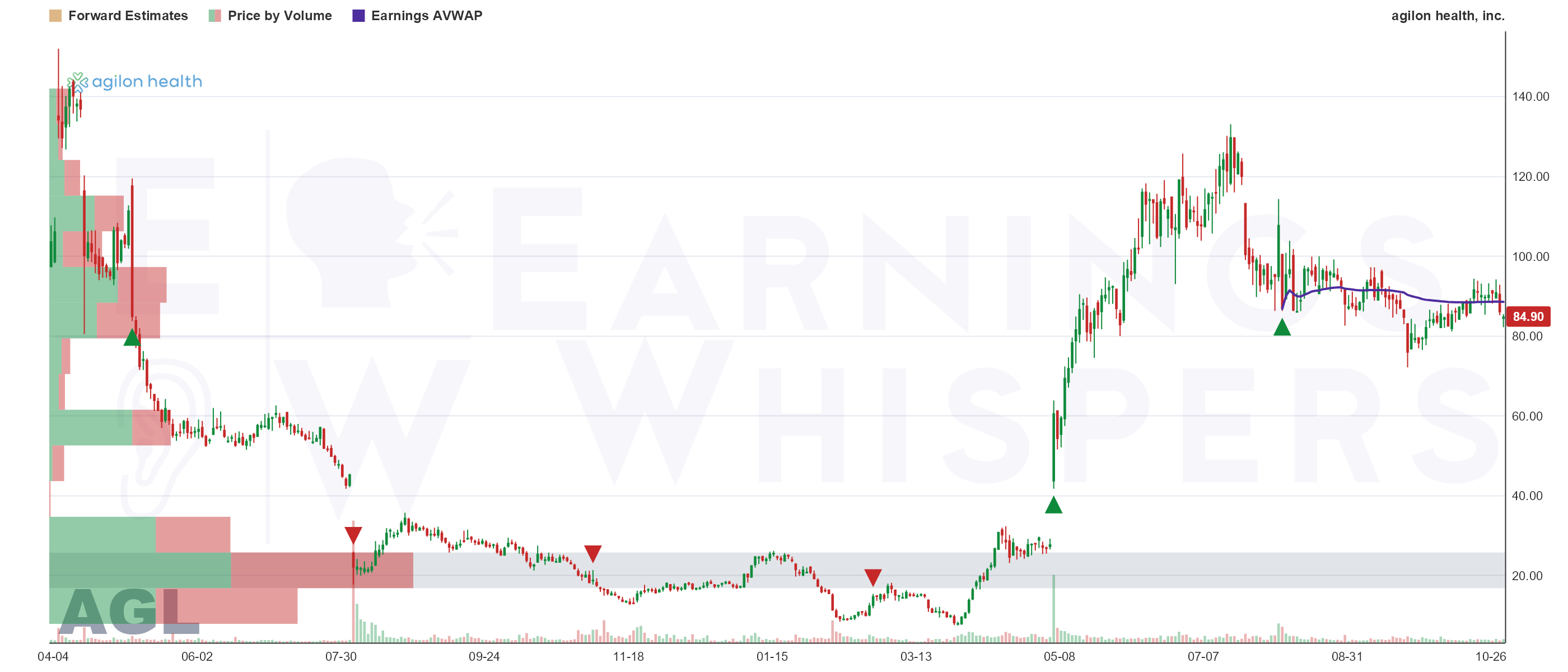
agilon health (AGL) reports after the close on Wednesday, November 4, 2026, with Wall Street bracing for a loss of $2.01 per share on revenue of $1.45 billion, up a modest 1.0% from a year ago and right inside the company's own $1.45 to $1.48 billion guide. Investors are leaning bearish into the print, with short interest up 4.6% since last quarter and the stock drifting 15.6% lower from where it opened after the last report. That said, it is still sitting a lofty 31.0% above its 200 day average of $64.79, estimates have actually been nudged higher, and option traders are betting on a hefty 10.2% swing when the numbers drop. Translation: nobody's bored.
Here's the real story. This company has quietly gone from turnaround project to comeback kid, raising full-year guidance three times running, with EBITDA now swinging solidly positive after a brutal year-ago stretch. New CEO Tim O'Rourke has ditched the 'fixing it' talk for 'the strategy is working,' and the numbers back him up, from fatter medical margins to better cost trends. The catch for this quarter: management's own guide points to a second-half slowdown, with Q3 penciled in around breakeven and a softer Q4, plus a deliberately cautious 7% cost assumption. They've also warned that a good chunk of this year's boost came from risk-adjustment gains that won't repeat as strongly in 2027, and roughly half of next year's payer contracts are still unsigned. So the question isn't whether the ship has turned. It's whether the back half holds the line.
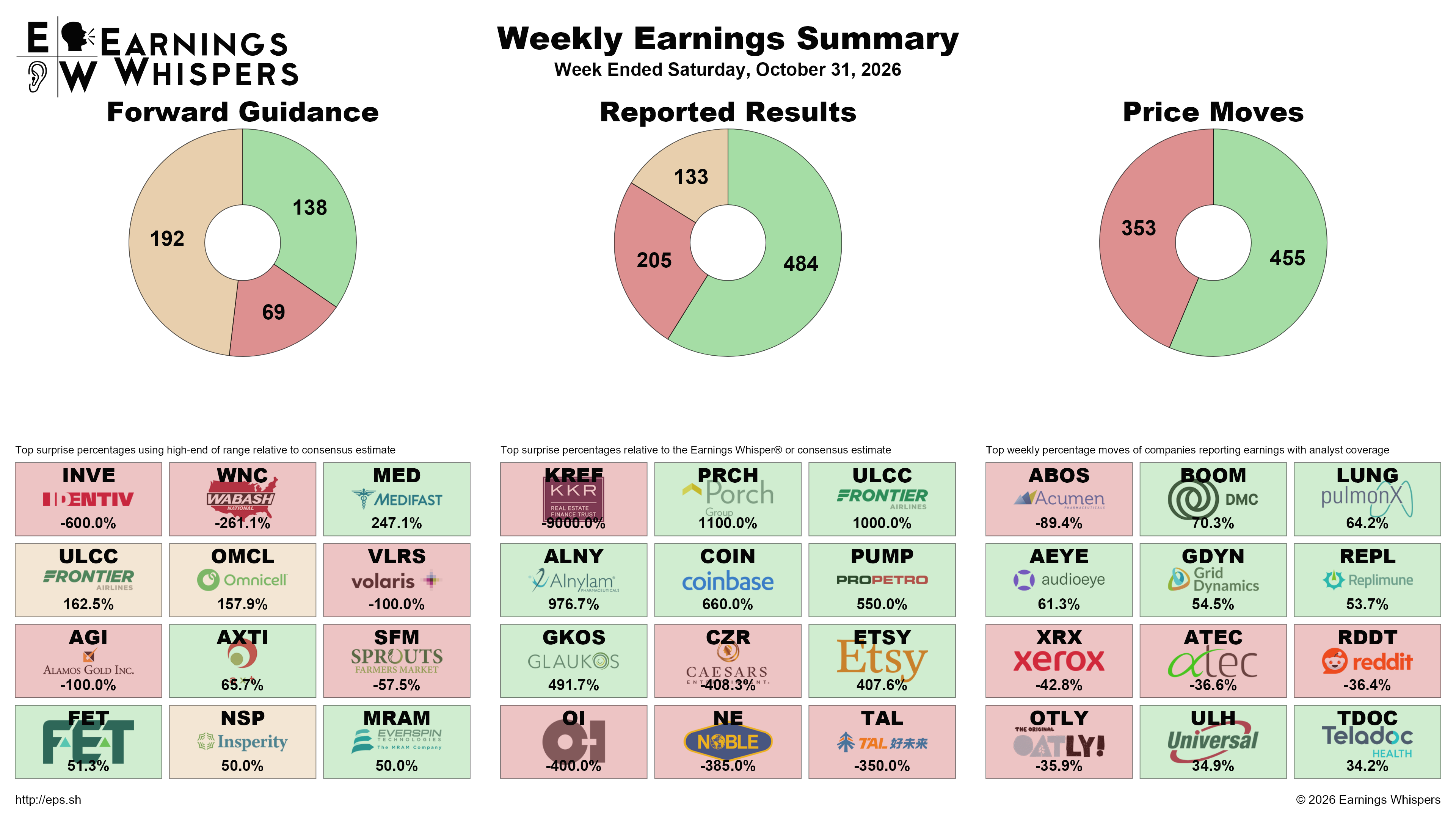
Big Tech's AI Cloud Boom Outshines Big Oil's Cash Gusher in a Blockbuster Earnings Week
It was a tale of two money machines last week, and both were printing. On one side, the tech giants showed that the artificial intelligence spending wave is finally showing up in the actual numbers, not just the hype. Amazon stole the show when it told investors its cloud business is now growing faster than 39% and promised to keep that pace north of 40% through 2028, even floating the idea of a trillion-dollar cloud empire down the road. Microsoft matched the energy, with its Azure cloud accelerating to 48% growth and management sounding more confident than ever, though a collapsing market for Windows PC software served as a reminder that not every corner is booming. Google, meanwhile, delivered a genuine jaw-dropper with cloud revenue more than doubling, yet investors still knocked the stock down hard, spooked by slowing search ads and the eye-watering bills piling up to build all this AI muscle. The common thread: demand is real, but so is the staggering cost, and Wall Street is starting to ask when the spending spree pays off.
The other half of the week belonged to Big Oil, where conflict-driven prices turned refineries and gas trading into cash gushers. TotalEnergies posted its strongest quarter of the cycle, jacking up its cash flow forecast and nearly doubling its buyback, while Shell, Exxon, Chevron and Phillips 66 all leaned into the good times with fatter dividends, debt paydowns and splashy new projects from Guyana to Venezuela. The catch is that much of this bounty rides on geopolitical tensions that could cool off at any moment, something executives quietly acknowledged. Away from tech and oil, the results got messier. Centene, the health insurer, raised its profit outlook for the third straight quarter as its Medicare bets paid off early, even as its core Medicaid membership keeps shrinking. Ford, by contrast, offered a mixed bag: solid cash flow and a small guidance bump, but a warning that 2027 profits will likely go nowhere as rising commodity costs and heavy electric-vehicle spending eat into the gains. The message across the board was that momentum is real, but the easy wins may be running out.
SanDisk Crushes It, But the Rocket Is Easing Off the Throttle
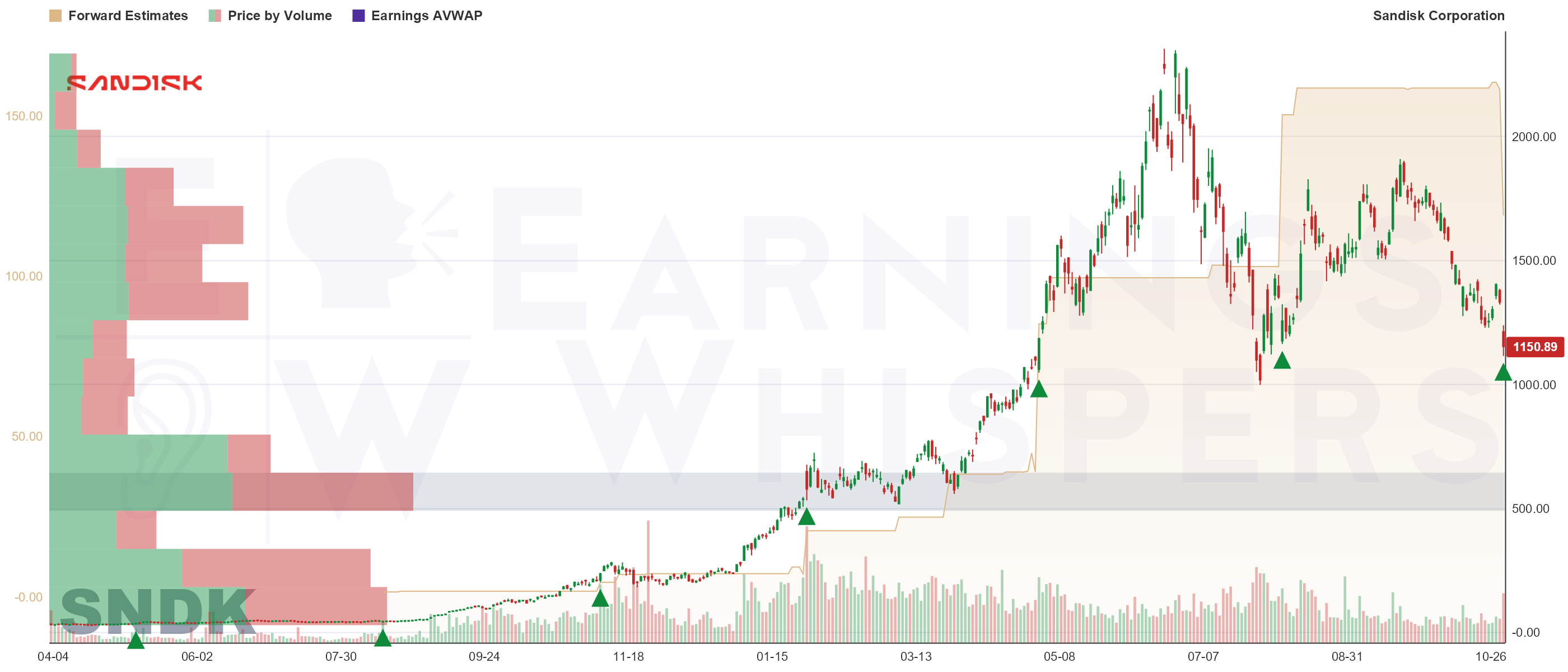
Sandisk (SNDK) just posted a blowout September quarter, earning $49.51 per share on revenue of $11.03 billion. Wall Street was looking for $47.20 on $10.58 billion, and the Earnings Whisper number was $49.13, so the company cleared every bar in sight. Revenue rocketed an eye-popping 378% versus a year ago, powered by data center demand that keeps showing up hungry for more. Management guided next quarter to revenue of $12.2 billion to $12.6 billion, comfortably ahead of the $12.0 billion the Street had penciled in. CEO David Goeckeler said the company is off to a strong start to fiscal 2027, with booming demand driving outsized growth in data center, and credited technology leadership, tight customer relationships, and disciplined spending for turning all that into growing free cash flow.
Here is the catch worth watching. The engine is still roaring, but it is no longer screaming. Growth from one quarter to the next is slowing to about 13%, down from 23% last quarter and a wild 51% before that, and more of that growth is now coming from selling more chips rather than charging more for them, which is a softer kind of tailwind. The consumer side dropped 29% as shoppers balked at higher prices, and PCs and phones remain weak. On the bright side, margins are still fat at 85%, the company is buying back stock hand over fist, and it announced an 8-for-1 stock split hitting November 20. Bottom line: a genuine beat and raise with visibility stretching to the end of the decade, just with the pace of the party cooling from a sprint to a strong jog.
Amazon Misses on Earnings, But AWS Is Firing on All Cylinders
Amazon.com (AMZN) posted earnings of $1.89 per share on revenue of $201.94 billion for the third quarter ended September 2026, coming up short of the $2.01 Wall Street was looking for and the $1.98 whisper number. That is a 4.55% miss on the bottom line, though revenue still climbed a healthy 12.09% from a year ago. Looking ahead, the company guided fourth quarter revenue to a range of $240.0 billion to $247.0 billion, which brackets the $245.7 billion analysts expected. Don't let the headline miss fool you though, because the real story here is the engine room, not the sticker price.
That engine room is AWS, Amazon's cloud business, and it is absolutely humming. Growth hit 39.3% in the quarter, the sixth straight time it has sped up, and management did something they have never done before by handing out a multi-year outlook calling for 40%-plus growth in both 2027 and 2028. CEO Andy Jassy even floated the idea that Amazon could end up with two trillion-dollar revenue businesses within the decade, which has never been done once, let alone twice. Company operating margin hit a record 13.9%, and the AWS order backlog ballooned to $578 billion. The soft spots, namely slower North America retail and advertising growth, are mostly a timing quirk from when Prime Day fell on the calendar and should bounce back next quarter. The one thing to keep an eye on is spending, with capex running hot at nearly $76 billion in the quarter and 2027 set to be "meaningfully more." Bottom line: a messy headline, but a genuinely strong quarter underneath.
Microsoft's Cloud Hits the Gas While Windows Hits the Skids
Microsoft (MSFT) posted earnings of $4.89 per share on revenue of $92.28 billion for its fiscal first quarter ending September 2026. Wall Street was looking for $4.71 per share on $90.58 billion, so revenue cruised past the mark with a juicy 18.80% jump from last year. The only hair in the soup: the Earnings Whisper number was $4.93, meaning MSFT technically came up a smidge short by 0.81%. Looking ahead, management guided second quarter earnings to $4.78 to $4.93 per share on revenue of $96.00 billion to $97.10 billion, comfortably ahead of the $4.84 and $95.70 billion the Street had penciled in. CEO Satya Nadella summed up the vibe by talking about giving customers more capability, choice, control, and cost efficiency across the whole stack, and translating that innovation into real-world adoption. In plain English, he says he has never been more confident.
Here is the real story. Azure is on a tear, growing 48% this quarter and guided to 49-50% next, a steady climb up from the 39-40% they promised a year ago. Microsoft Cloud hit $63.9 billion, up 30%, and operating margin punched up to roughly 50% versus 45% last quarter. AI is clearly selling, with Foundry customers jumping to 120K, Volkswagen rolling out Copilot to 330,000 employees, and a backlog of future business that ballooned 73%. The fly in the ointment is the old-school PC business. Windows OEM sales fell a nasty 27% and are guided down into the mid-30s next quarter as stores sit on too much inventory. There is also a supply hiccup, with GPU chip deliveries pushed to later in the year, trimming their big spending plans. Bottom line: the fast-growing, high-margin parts of Microsoft are accelerating, while the weak spots are either small or just a matter of timing. This one is a clear winner.
Alphabet: Cloud on Fire, Cash Flow in the Hot Seat
Alphabet Cl A (GOOGL) posted earnings of $2.12 per share on revenue of $127.58 billion for the third quarter ended September 2026, a wide miss against the $2.94 consensus and the $3.08 Earnings Whisper number. On paper that looks ugly, down 31% versus expectations, but the bruise is mostly cosmetic: an $8.2 billion paper loss on the company's SpaceX stake dragged the bottom line lower. Strip that out and the story is very different. Revenue still climbed a healthy 24.65% year over year. CEO Sundar Pichai said Alphabet is now running at a half-trillion dollar revenue pace, crediting the company's soup-to-nuts approach for momentum across the business. For the uninitiated, Alphabet is the parent of Google, the search and advertising giant that also makes operating systems, cloud services and hardware.
Here is the real tug of war. Google Cloud is absolutely ripping, with revenue up 103% to $30.7 billion and a backlog now at a jaw-dropping $561 billion, while the new Gemini 4 models and 1 billion Gemini app users show the AI bet is paying off. The catch is that the old reliable, search advertising, cooled to 12% growth from 17%, YouTube ads slowed, and free cash flow went deeper into the red at negative $9.1 billion as the company stockpiles its own AI chips and swallows a $5.2 billion EU fine. Add rising debt and nearly a trillion dollars in future purchase commitments, and you get a company spending like a sailor on shore leave to win the AI race. Exciting, yes. But watch the cash flow and the ad engine closely before celebrating.
Intel's Servers Soar While PCs Faceplant
Intel (INTC) posted third quarter earnings of $0.52 per share on revenue of $16.51 billion for the quarter ended September 2026, cruising past the $0.39 consensus and the $0.47 Earnings Whisper number. That is a 10.64% beat, with revenue up a hefty 20.95% from a year ago. So far, so good. But the champagne went flat with guidance: Intel expects fourth quarter earnings of just $0.25 per share on revenue of $15.0 to $16.0 billion, well short of the $0.42 and $16.8 billion Wall Street was counting on. CEO Lip-Bu Tan talked up improving execution, expanding supply, and robust CPU demand, while admitting the PC industry is throwing some punches. His main job now is cranking out more chips to feed the hungry Xeon crowd.
Here is the real story. Intel's data center business is on fire, with that segment nearly doubling from last year and demand for server chips so strong the company cannot make them fast enough through 2027 and into 2028. That is the good news. The bad news is piling up fast: the PC market is in a nasty slump driven by memory shortages, a factory accident in Israel is set to cost around $300 million in sales and squeeze margins, and profitability is sliding from 44.1% down to 38% next quarter, breaking a promise to stay comfortably in the 40s. On top of that, Intel now expects to burn cash in 2027 as it spends big on new factories. Translation: the long-term engine looks great, but the next couple of quarters are going to be a bumpy ride.
Beyond the silicon, there is plenty for everyone. Travel and leisure fans get a triple feature with Marriott, Booking, and Airbnb, and the early read on Airbnb in particular looks sunny, with solid underlying trends. Healthcare offers a study in contrasts: Pfizer and Novo Nordisk face a chillier reception, while Cardinal Health and CVS have been building quiet goodwill. Consumer staples lovers should keep an eye on McDonald's and Clorox, both of which look to be swimming against the current, and the speculative corner of the market will be glued to names like IonQ, SoundHound, and a handful of crypto miners that tend to move first and explain later. A word to the wise for anyone tempted to trade the headline alone: several of these companies, especially in the hotter tech pockets, have a habit of popping on the news and then quietly fading in the days after, so the first reaction is rarely the final word.
Apple's Hot Demand Runs Into a Memory-Cost Flood
Apple (AAPL) steps up to the plate Monday, November 2, 2026, right around 4:30 PM ET. Wall Street is looking for $1.98 per share on $112.95 billion in sales, which would be a healthy 10.2% jump from a year ago, while the Earnings Whisper number sits a touch higher at $2.07. Apple's own guidance called for $1.91 to $2.04 per share on $111.69 billion to $113.74 billion. Here's the funny part: investors are feeling bearish going in, yet 55.3% still expect a beat, so even the pessimists are hedging their bets. Short sellers have backed off by 10.2% since last quarter, the stock has climbed 13.1% since its last post-earnings open, and it now sits 16.3% above its 200 day average of $296.37. Estimates have been nudged higher across the board. Options traders are bracing for a 4.9% swing, a bit more than the usual 3.0% move, and on October 27 someone grabbed 72,152 of the $380 calls expiring January 15, 2027, a clear bet that the party keeps going.
The real story is a good problem bumping into real trouble. iPhone demand is flat out staggering, with revenue up around 22% and buyers lining up faster than Apple can build phones. But that same shortage is now spreading from Macs to iPhones and iPads, and a so-called hundred-year flood in memory chip prices is squeezing margins hard enough that Apple quietly raised prices across the lineup. On top of that, Services growth cooled off and last quarter's guidance stepped down about 500 basis points. The bright spots are real, the Siri AI rollout is landing well, China approved its AI features, and schools and big firms are swapping out Windows machines for Macs. Oh, and this is the first full quarter with John Ternus in the driver's seat after Tim Cook's handoff. Bottom line: the demand is there, but the margins and guidance are the ones everyone will be watching.
Palantir Heads Into Earnings Red Hot With Bulls Piling In
Palantir Technologies (PLTR) steps up to report after the close on Monday, November 2, 2026, around 4:05 PM ET. Wall Street is looking for $0.40 per share on $2.17 billion in revenue, which would be a whopping 83.7% jump from a year ago, but the whisper number is running hotter at $0.49. The company guided to roughly $2.16 billion, and the crowd is clearly feeling good about this one with nearly 71% expecting a beat. The doubters are heading for the exits too, as short interest has dropped 28% since last quarter while the stock has climbed 26.8% and now sits nearly 20% above its 200 day average of $153.69. Earnings estimates keep marching higher. Options traders are bracing for a 13.4% swing, a touch bigger than the 11.8% average move lately, and one trader made a notable bet buying over 30,000 of the $160 puts expiring in mid December, so somebody is hedging for a bumpy landing.
Here is the real story heading in. Last quarter was about as good as it gets, with total revenue growth hitting a record 93% and management delivering its largest full-year raise ever. The hot new theme is sovereign AI, meaning customers get to own their own model weights and keep everything inside their own walls, which is pulling in big executive interest and even waking up old dormant clients. The NVIDIA partnership and the Maven government platform add more fuel. The only real soft spots are a slight dip in gross margin, since Palantir took on cloud hosting costs for a government client, a big spending ramp coming this quarter, and Europe still dragging its feet. CEO Alex Karp is talking a very confident game and promising strong growth for the next 18 months, so the bar is set high and the crowd expects him to clear it.
AMD's Data Center Rocket Meets a Gaming Speed Bump
Advanced Micro Devices (AMD) steps up to the earnings plate on Tuesday, November 3, 2026 at roughly 4:15 PM ET, and Wall Street is leaning in. The crowd wants $1.94 per share on $13.12 billion in revenue, which would be a hefty 41.9% jump from a year ago, while our whisper number nudges a touch higher to $1.98. Management had guided revenue to a range of $12.70 billion to $13.30 billion, so they are playing right in their own wheelhouse. Sentiment is downright sunny, with 74.5% of investors betting on a beat. Short sellers have backed off by 4.2%, the stock has climbed 4.2% since last quarter's report, and it now sits a lofty 23.3% above its 200 day moving average of $409.56. Estimates have been marching higher across the board. Buckle up, because options traders are bracing for a 10.2% swing, roughly in line with the 8.9% average lately, and on October 15 someone scooped up 17,920 of the $440 puts expiring November 20, so not everyone is drinking the punch.
Here is the real story heading in: the data center business has become a freight train. Last quarter that segment hit $6.7 billion, up a staggering 107% from a year ago, and it now makes up 58% of the whole company versus 42% a year back. Management keeps cranking up its targets, adding Anthropic and an expanded Microsoft Azure deal to a client list that already includes OpenAI and Meta, and they flat out said they expect to blow past their long term goals, including $20 in earnings. The Helios chips are shipping ahead of plan and server chip demand is the strongest ever. The one wart is gaming, which fell 31% and is set to drop by strong double digits again as the console cycle ages, plus a softer PC market thanks to rising memory costs. But that is a sideshow. If the data center keeps roaring, nobody will be fretting about consoles.
DIBS: Fixing Itself While the Luxury Market Sits This One Out
1stdibs.com (DIBS) is set to report earnings Thursday, November 5, 2026 at around 7:00 AM ET. Wall Street is looking for a loss of $0.04 per share on revenue of $22.36 million, which would be a modest 1.8% bump from a year ago, though the Earnings Whisper number is a slightly less painful loss of $0.02. Management guided revenue to $22.00 to $22.90 million. The crowd is practically giddy here, with 97.2% of investors betting on a beat. Short interest has eased 1.9% since last quarter, and the stock has slipped 1.2% since the last report, now sitting 2.2% above its 200 day moving average of $4.84. Estimates haven't budged, but buckle up: this stock has swung an average of 8.6% after recent prints.
Here's the real story. Last quarter the online marketplace for fancy furniture and art did something it wasn't supposed to do until late this year, it flipped back to growth, with sales volume up 7% and a full-year outlook raise to boot. That's impressive because the high-end housing market is basically napping near a 30-year low, so none of this growth is coming from the economy. It's all homegrown stuff like visual search, personalized recommendations, an AI chatbot, and smarter freight quoting. The catch: they're selling pricier items that carry lower fees, so revenue trails behind volume, buyer counts keep shrinking after marketing cuts, and the cash pile dropped to $67.7 million. The thing to watch is whether this self-help engine keeps humming through a seasonally soft quarter. If it does, the bulls look smart.
AppLovin: After the Stumble, Can the New Model Stick the Landing?
AppLovin (APP) steps up to the plate after the bell on Wednesday, November 4, 2026 at roughly 4:05 PM ET. Wall Street is looking for $3.94 per share on $2.08 billion in revenue, which would be a hearty 48% jump from a year ago, while the Whisper number sits a touch higher at $4.05. Management had guided to revenue of $2.06 to $2.09 billion, so they boxed themselves in nicely. The crowd is feeling good, with 79.3% betting on a beat, and short sellers have backed off by 11.2% since last quarter. Here is the twist though: the stock has slid 32.5% since its last earnings reaction and now trades a jaw-dropping 45.2% below its 200 day average of $416.82. Options traders are bracing for a 19.3% swing, bigger than the 11.7% average lately, and someone made a big bearish bet on October 15, scooping up 11,239 of the $200 puts expiring November 20.
Here is the real story. Last quarter snapped AppLovin's long winning streak with its first true miss on both revenue and profit, and it was not pretty for the tone, which went from the future never looking better to this was not the quarter we hold ourselves to. The company blamed timing, saying its new AI model upgrade landed just after the quarter closed and is now live, so Q3 is supposed to re-accelerate. But growth is clearly cooling, margins are getting squeezed by higher computing costs, free cash flow dropped, and they even trimmed buybacks. The good news is the consumer and e-commerce side keeps setting records, the new Ads Manager and Triple Whale style partnerships are real, and that SEC inquiry closed with no action. Bottom line: this is a reset-and-prove-it quarter, and investors want to see that the new model actually delivers the rebound management promised. Estimates have drifted lower, so the bar is a bit easier, but the stock's beaten-down price says the market needs convincing.
AEHR Heats Up: Big Growth Story Meets a Nervous Crowd
Aehr Test Systems (AEHR) is locked in to report earnings on Monday, November 2, 2026 at about 4:05 PM ET. Wall Street is looking for $0.11 per share on revenue of $27.45 million, which would be a whopping 150.3% jump in sales from a year ago, while the Earnings Whisper number sits higher at $0.15. The mood is cautiously optimistic, with 41.7% of investors betting on a beat. But here is the tension: short interest has jumped 35.0% since last quarter, and the stock has slid 44.1% from where it opened after the last report, now sitting 26.0% below its 200 day moving average of $74.16. Analysts have also been trimming their estimates lately. Option traders are bracing for a 20.2% swing, right in line with the roughly 20.4% move this stock has thrown off in recent quarters. One eye-catcher: on Friday, October 16, someone scooped up 1,475 of the $50.00 puts expiring January 15, 2027, a bet that things could get bumpier.
Here is the real story heading in. Last quarter was a turning point. The company posted record bookings of $60.7 million, up more than 500% from a year ago, and backlog hit a record $80.6 million. Management rolled out its first ever full-year guide of $130 to $150 million for fiscal 2027, roughly triple last year's $50 million, and said they could go higher without hitting a capacity wall. A make-or-break AI chip test finally passed with flying colors, and that customer is moving to pilot production with more on the table that is not even in the guidance yet. Silicon carbide, which had been dragging, is showing signs of life too. The catch is that the trailing numbers still look soft, memory revenue is left out of the guide entirely, and the business leans heavily on just a few big customers. So the question investors want answered is simple: do the shiny forward numbers start showing up in the actual results, or does the lumpy, concentrated nature of this business keep the stock on a roller coaster.
Tempus: Profitable and Loaded for a Bigger Swing
Tempus reports before the bell, with Wall Street penciling in a loss of $0.08 per share on revenue of $411.34 million, good for 23.1% year-over-year growth, while the Earnings Whisper number is a much skinnier loss of just $0.01. Sentiment is leaning bearish, though a brave 15.0% of the crowd expects a beat. Short sellers have been backing off, with short interest down 16.4% since last quarter, and they have reason to, as the stock has climbed 56.2% from its post-earnings open and now sits 26.7% above its 200 day moving average of $57.00. The catch is that overall earnings estimates have been trimmed lower since last quarter. Options traders are bracing for a 15.3% swing, which is a big step up from the 4.7% average move of recent quarters, and on Thursday, October 22, someone grabbed 2,667 of the $60.00 puts expiring November 20, so not everyone is feeling warm and fuzzy.
Last quarter was a turning point. The company posted its first-ever positive GAAP net income of $5.6 million, swung adjusted EBITDA into the black, and raised full-year guidance yet again to roughly 25% growth, all while promising positive free cash flow by year-end. The real story is the pipeline of growth levers: FDA approval of its tumor-only test unlocks an estimated $85 million a year starting in 2027, a lifted pricing assumption on its liquid biopsy test points to a combined $400 million revenue boost by 2028, and the pending Personalis deal pushes Tempus into the $20 billion-plus market for tracking cancer that comes back. The one thing to watch is that headline growth slowed to 22% from 36%, but that is simply the company lapping last year's Ambry acquisition, not a sign the engine is sputtering. Keep an eye on whether management can keep the profitability momentum going while swallowing Personalis.
Shopify Heads Into Earnings With the Wind at Its Back
Shopify (SHOP) is set to report earnings before the bell on Tuesday, November 3, 2026, at around 7:00 AM ET. Wall Street is looking for $0.45 per share on $3.74 billion in revenue, which would be a punchy 31.5% jump from a year ago, though the smart money Whisper number sits a touch higher at $0.48. Management themselves guided to about $3.76 billion. The crowd is feeling good here, with 75% betting on a beat. Short sellers have been heading for the exits too, with short interest down almost 22% since last quarter, while the stock has quietly drifted 5% higher and now sits a comfy 21% above its 200 day average of $130.02. Analysts have been nudging their numbers up, not down. That said, the options crowd is bracing for fireworks, pricing in a 14.6% swing versus the 11.5% average move SHOP usually serves up. One eyebrow raiser: on Friday someone scooped up 8,169 of the $110 puts expiring December 18, so not everyone is drinking the champagne just yet.
Coming off last quarter, the story is simply momentum. Shopify raised its guide and then blew past it, posting 34% revenue growth after guiding to the high 20s, and GMV cleared $116 billion for a fifth straight quarter above 30% growth. Free cash flow margin climbed to 18%, costs got leaner, and payments penetration ticked up to 68%. The big flex is the AI and agentic commerce push, with its Universal Commerce Protocol now adopted by dozens of retailers and Sidekick custom apps tripling to 36,000. The watch items are modest: the splashy AI traffic growth cooled from roughly 13x to 3x, and those AI costs are still nibbling at subscription margins. Nothing broken here, just a lot of things going right.
Qualcomm's Phone Business Fades as It Bets Big on Data Centers and Cars
Qualcomm (QCOM) reports after the bell on Wednesday, November 4, 2026, around 4:00 PM ET. Wall Street is looking for $2.16 per share on $10.15 billion in revenue, which would be a 9.9% drop from a year ago, while the Earnings Whisper number sits a touch higher at $2.19. Management guided to $2.05 to $2.25 per share on $9.70 billion to $10.50 billion. Investors are nervous heading in, yet a whopping 88.9% still expect a beat. Short sellers have backed off by 17.5% since last quarter, and the stock has climbed 12.4% off its post-earnings open, landing just 2.8% below its 200 day average of $169.50. Analysts have been trimming estimates lately, and options traders are bracing for a 10.5% swing, bigger than the 7.8% average lately. One eyebrow-raiser: last Friday someone scooped up 5,294 of the $175 puts expiring November 6, so at least one trader is buying insurance.
Here is the real story. Qualcomm's bread-and-butter phone chip business is getting squeezed hard. Handset revenue has been sliding quarter after quarter, memory prices are through the roof, and Apple is walking out the door faster than expected, with its chip share now well below the old 20% assumption and a roughly 50% revenue drop looming. That alone is more than a $1.50 hit to earnings. The flip side is the growth story management keeps hammering: they doubled their long-term non-handset target to over $40 billion by 2029, locked in two custom data center chip wins that start producing revenue this December quarter, bagged a landmark BMW deal for self-driving and cockpit chips, and bought an AI software company. So this is a classic tug of war. Today's numbers are shrinking, but tomorrow's bets are getting bigger and bolder. Watch the guidance and whether those data center and auto wins are real enough to outrun the fading iPhone paycheck.
Uber's AV Dreams Meet a Bearish Crowd Betting on a Beat
Uber Technologies (UBER) rolls up to report earnings on Wednesday, November 4, 2026 at about 6:55 AM ET, and the setup is a bit of a head-scratcher. Wall Street is looking for $0.94 per share on $14.74 billion in revenue, good for 9.5% growth, but the Earnings Whisper number sits higher at a clean $1.00. That's well above the company's own guidance of $0.84 to $0.88, which tells you management likes to set the bar low and then hop over it. Here's the funny part: investors are feeling bearish heading in, yet a full 100% of them expect a beat. Short sellers seem to agree something's cooking, trimming their bets by 5.8% since last quarter. Meanwhile the stock has drifted 5.4% lower since its last report and now trades 11.1% under its 200 day average of $73.39. Options traders are bracing for an 8.3% swing, even though Uber usually moves a tamer 4.5%. One trader made a statement on October 21 by scooping up 24,044 of the $115 calls expiring in January 2028, which is a loud vote for better days ahead.
The real story behind this quarter is momentum, and last call it was firing on all cylinders. Gross bookings grew 22% and topped $58 billion, earnings jumped 35%, and free cash flow crossed $10 billion for the first time ever. US mobility finally caught fire and Uber One loyalty members blew past 50 million. The bigger swing-for-the-fences moves are the planned Delivery Hero buyout that roughly doubles its markets and a $10 billion push into self-driving cars with partners like NVIDIA, Rivian and Zoox lined up. Watch for a couple of wrinkles though. Mobility take rate dropped about 500 basis points, mostly an accounting quirk from a UK change, and Brazil is getting scrappy as rival food delivery players bid up courier pay. Buybacks also cooled to roughly $3.5 billion as cash shifted toward the Delivery Hero stake. None of it is alarming, just the price of growing fast and thinking big.
Agilon's Turnaround Gets Real, But the Back Half Is the Test
agilon health (AGL) reports after the close on Wednesday, November 4, 2026, with Wall Street bracing for a loss of $2.01 per share on revenue of $1.45 billion, up a modest 1.0% from a year ago and right inside the company's own $1.45 to $1.48 billion guide. Investors are leaning bearish into the print, with short interest up 4.6% since last quarter and the stock drifting 15.6% lower from where it opened after the last report. That said, it is still sitting a lofty 31.0% above its 200 day average of $64.79, estimates have actually been nudged higher, and option traders are betting on a hefty 10.2% swing when the numbers drop. Translation: nobody's bored.
Here's the real story. This company has quietly gone from turnaround project to comeback kid, raising full-year guidance three times running, with EBITDA now swinging solidly positive after a brutal year-ago stretch. New CEO Tim O'Rourke has ditched the 'fixing it' talk for 'the strategy is working,' and the numbers back him up, from fatter medical margins to better cost trends. The catch for this quarter: management's own guide points to a second-half slowdown, with Q3 penciled in around breakeven and a softer Q4, plus a deliberately cautious 7% cost assumption. They've also warned that a good chunk of this year's boost came from risk-adjustment gains that won't repeat as strongly in 2027, and roughly half of next year's payer contracts are still unsigned. So the question isn't whether the ship has turned. It's whether the back half holds the line.
Big Tech's AI Cloud Boom Outshines Big Oil's Cash Gusher in a Blockbuster Earnings Week
It was a tale of two money machines last week, and both were printing. On one side, the tech giants showed that the artificial intelligence spending wave is finally showing up in the actual numbers, not just the hype. Amazon stole the show when it told investors its cloud business is now growing faster than 39% and promised to keep that pace north of 40% through 2028, even floating the idea of a trillion-dollar cloud empire down the road. Microsoft matched the energy, with its Azure cloud accelerating to 48% growth and management sounding more confident than ever, though a collapsing market for Windows PC software served as a reminder that not every corner is booming. Google, meanwhile, delivered a genuine jaw-dropper with cloud revenue more than doubling, yet investors still knocked the stock down hard, spooked by slowing search ads and the eye-watering bills piling up to build all this AI muscle. The common thread: demand is real, but so is the staggering cost, and Wall Street is starting to ask when the spending spree pays off.
The other half of the week belonged to Big Oil, where conflict-driven prices turned refineries and gas trading into cash gushers. TotalEnergies posted its strongest quarter of the cycle, jacking up its cash flow forecast and nearly doubling its buyback, while Shell, Exxon, Chevron and Phillips 66 all leaned into the good times with fatter dividends, debt paydowns and splashy new projects from Guyana to Venezuela. The catch is that much of this bounty rides on geopolitical tensions that could cool off at any moment, something executives quietly acknowledged. Away from tech and oil, the results got messier. Centene, the health insurer, raised its profit outlook for the third straight quarter as its Medicare bets paid off early, even as its core Medicaid membership keeps shrinking. Ford, by contrast, offered a mixed bag: solid cash flow and a small guidance bump, but a warning that 2027 profits will likely go nowhere as rising commodity costs and heavy electric-vehicle spending eat into the gains. The message across the board was that momentum is real, but the easy wins may be running out.
SanDisk Crushes It, But the Rocket Is Easing Off the Throttle
Sandisk (SNDK) just posted a blowout September quarter, earning $49.51 per share on revenue of $11.03 billion. Wall Street was looking for $47.20 on $10.58 billion, and the Earnings Whisper number was $49.13, so the company cleared every bar in sight. Revenue rocketed an eye-popping 378% versus a year ago, powered by data center demand that keeps showing up hungry for more. Management guided next quarter to revenue of $12.2 billion to $12.6 billion, comfortably ahead of the $12.0 billion the Street had penciled in. CEO David Goeckeler said the company is off to a strong start to fiscal 2027, with booming demand driving outsized growth in data center, and credited technology leadership, tight customer relationships, and disciplined spending for turning all that into growing free cash flow.
Here is the catch worth watching. The engine is still roaring, but it is no longer screaming. Growth from one quarter to the next is slowing to about 13%, down from 23% last quarter and a wild 51% before that, and more of that growth is now coming from selling more chips rather than charging more for them, which is a softer kind of tailwind. The consumer side dropped 29% as shoppers balked at higher prices, and PCs and phones remain weak. On the bright side, margins are still fat at 85%, the company is buying back stock hand over fist, and it announced an 8-for-1 stock split hitting November 20. Bottom line: a genuine beat and raise with visibility stretching to the end of the decade, just with the pace of the party cooling from a sprint to a strong jog.
Amazon Misses on Earnings, But AWS Is Firing on All Cylinders
Amazon.com (AMZN) posted earnings of $1.89 per share on revenue of $201.94 billion for the third quarter ended September 2026, coming up short of the $2.01 Wall Street was looking for and the $1.98 whisper number. That is a 4.55% miss on the bottom line, though revenue still climbed a healthy 12.09% from a year ago. Looking ahead, the company guided fourth quarter revenue to a range of $240.0 billion to $247.0 billion, which brackets the $245.7 billion analysts expected. Don't let the headline miss fool you though, because the real story here is the engine room, not the sticker price.
That engine room is AWS, Amazon's cloud business, and it is absolutely humming. Growth hit 39.3% in the quarter, the sixth straight time it has sped up, and management did something they have never done before by handing out a multi-year outlook calling for 40%-plus growth in both 2027 and 2028. CEO Andy Jassy even floated the idea that Amazon could end up with two trillion-dollar revenue businesses within the decade, which has never been done once, let alone twice. Company operating margin hit a record 13.9%, and the AWS order backlog ballooned to $578 billion. The soft spots, namely slower North America retail and advertising growth, are mostly a timing quirk from when Prime Day fell on the calendar and should bounce back next quarter. The one thing to keep an eye on is spending, with capex running hot at nearly $76 billion in the quarter and 2027 set to be "meaningfully more." Bottom line: a messy headline, but a genuinely strong quarter underneath.
Microsoft's Cloud Hits the Gas While Windows Hits the Skids
Microsoft (MSFT) posted earnings of $4.89 per share on revenue of $92.28 billion for its fiscal first quarter ending September 2026. Wall Street was looking for $4.71 per share on $90.58 billion, so revenue cruised past the mark with a juicy 18.80% jump from last year. The only hair in the soup: the Earnings Whisper number was $4.93, meaning MSFT technically came up a smidge short by 0.81%. Looking ahead, management guided second quarter earnings to $4.78 to $4.93 per share on revenue of $96.00 billion to $97.10 billion, comfortably ahead of the $4.84 and $95.70 billion the Street had penciled in. CEO Satya Nadella summed up the vibe by talking about giving customers more capability, choice, control, and cost efficiency across the whole stack, and translating that innovation into real-world adoption. In plain English, he says he has never been more confident.
Here is the real story. Azure is on a tear, growing 48% this quarter and guided to 49-50% next, a steady climb up from the 39-40% they promised a year ago. Microsoft Cloud hit $63.9 billion, up 30%, and operating margin punched up to roughly 50% versus 45% last quarter. AI is clearly selling, with Foundry customers jumping to 120K, Volkswagen rolling out Copilot to 330,000 employees, and a backlog of future business that ballooned 73%. The fly in the ointment is the old-school PC business. Windows OEM sales fell a nasty 27% and are guided down into the mid-30s next quarter as stores sit on too much inventory. There is also a supply hiccup, with GPU chip deliveries pushed to later in the year, trimming their big spending plans. Bottom line: the fast-growing, high-margin parts of Microsoft are accelerating, while the weak spots are either small or just a matter of timing. This one is a clear winner.
Alphabet: Cloud on Fire, Cash Flow in the Hot Seat
Alphabet Cl A (GOOGL) posted earnings of $2.12 per share on revenue of $127.58 billion for the third quarter ended September 2026, a wide miss against the $2.94 consensus and the $3.08 Earnings Whisper number. On paper that looks ugly, down 31% versus expectations, but the bruise is mostly cosmetic: an $8.2 billion paper loss on the company's SpaceX stake dragged the bottom line lower. Strip that out and the story is very different. Revenue still climbed a healthy 24.65% year over year. CEO Sundar Pichai said Alphabet is now running at a half-trillion dollar revenue pace, crediting the company's soup-to-nuts approach for momentum across the business. For the uninitiated, Alphabet is the parent of Google, the search and advertising giant that also makes operating systems, cloud services and hardware.
Here is the real tug of war. Google Cloud is absolutely ripping, with revenue up 103% to $30.7 billion and a backlog now at a jaw-dropping $561 billion, while the new Gemini 4 models and 1 billion Gemini app users show the AI bet is paying off. The catch is that the old reliable, search advertising, cooled to 12% growth from 17%, YouTube ads slowed, and free cash flow went deeper into the red at negative $9.1 billion as the company stockpiles its own AI chips and swallows a $5.2 billion EU fine. Add rising debt and nearly a trillion dollars in future purchase commitments, and you get a company spending like a sailor on shore leave to win the AI race. Exciting, yes. But watch the cash flow and the ad engine closely before celebrating.
Intel's Servers Soar While PCs Faceplant
Intel (INTC) posted third quarter earnings of $0.52 per share on revenue of $16.51 billion for the quarter ended September 2026, cruising past the $0.39 consensus and the $0.47 Earnings Whisper number. That is a 10.64% beat, with revenue up a hefty 20.95% from a year ago. So far, so good. But the champagne went flat with guidance: Intel expects fourth quarter earnings of just $0.25 per share on revenue of $15.0 to $16.0 billion, well short of the $0.42 and $16.8 billion Wall Street was counting on. CEO Lip-Bu Tan talked up improving execution, expanding supply, and robust CPU demand, while admitting the PC industry is throwing some punches. His main job now is cranking out more chips to feed the hungry Xeon crowd.
Here is the real story. Intel's data center business is on fire, with that segment nearly doubling from last year and demand for server chips so strong the company cannot make them fast enough through 2027 and into 2028. That is the good news. The bad news is piling up fast: the PC market is in a nasty slump driven by memory shortages, a factory accident in Israel is set to cost around $300 million in sales and squeeze margins, and profitability is sliding from 44.1% down to 38% next quarter, breaking a promise to stay comfortably in the 40s. On top of that, Intel now expects to burn cash in 2027 as it spends big on new factories. Translation: the long-term engine looks great, but the next couple of quarters are going to be a bumpy ride.